




Starlink Management Platform

Take Control of Your Starlink Network

Aavora is your central platform for managing Starlink terminals at scale. Gain real-time visibility, control subscriptions, track usage, and streamline operations — all through a single, powerful interface designed for enterprise performance.

For Starlink Enterprise

Customers & Resellers

Customers
0 +
Subscriptions
0 +
Data Processed PM
0 PB+
Cost Reduction
0 %

Built to Support Critical Sectors:

Marine & Offshore

Whether it’s managing vessels, rigs, or floating infrastructure. Aavora gives you and your customers full visibility and control over your Starlink estate — wherever you operate.

  • Oil & Gas
  • Offshore Rigs
  • Fishing vessels
  • Cargo Ships
  • Wind Farms
  • Research Vessels
  • Life Boats
  • Private Yachts

Fixed/Land

From fast-moving building sites to large-scale infrastructure projects, Aavora ensures seamless Starlink deployment and data oversight. Ideal for construction firms, civil engineering contractors, and house builders who need reliable, agile connectivity across dynamic environments.

  • Construction
  • Energy
  • Healthcare
  • Manufacturing
  • Mining
  • Retail
  • Agriculture
  • Rural Communities

Mobility/Emergency Services

Built for public sector resilience, Aavora empowers emergency services, healthcare providers, and government teams to manage Starlink connectivity with confidence. From ambulances to field response units, Aavora delivers real-time control and insight where it matters most.

  • Broadcast
  • Logistics
  • Transport
  • Welfare
  • Rail
  • Emergency Services
  • Coastguard
  • Humanitarian

Built for Scale.

Designed for Clarity.

Aavora simplifies how you manage Starlink at scale — giving you a centralised hub to deploy, monitor, and control any number of terminals across regions, fleets, or business units. Whether you’re growing fast or already global, Aavora adapts to your operations.

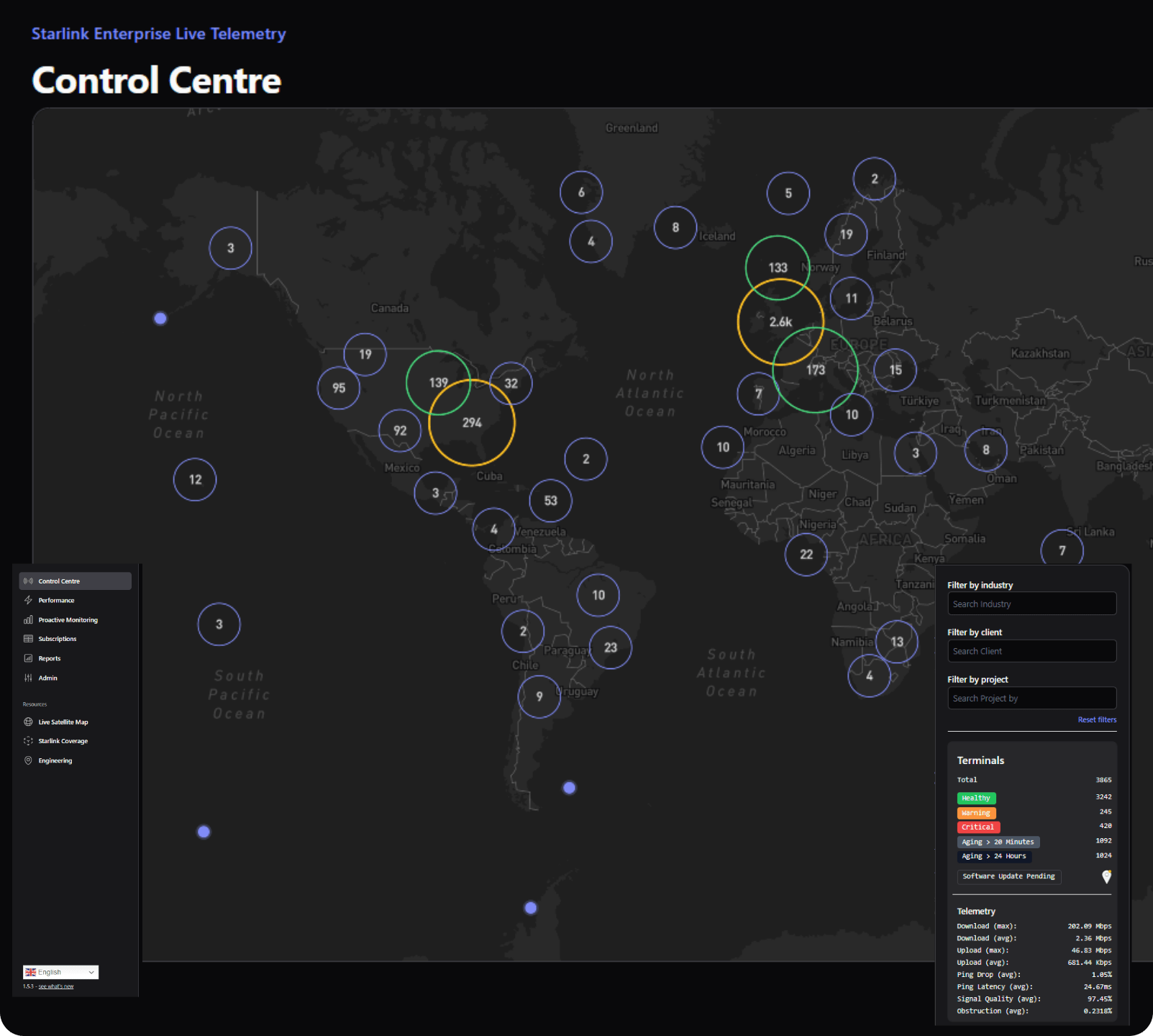
Live Global Map:

Gain a live, geospatial view of your entire Starlink deployment on one map-based dashboard

Manage all terminals and plans from one secure platform.

Support small teams or global operations without added complexity.

Organise terminals by site, team, or project for faster access.

Total Visibility.

Every Terminal.

From big-picture trends to individual terminal diagnostics, Aavora offers full visibility into your network’s performance. View real-time metrics, terminal locations, satellite overlays, and historical data — all in one powerful interface.

Satellite Awareness:
View satellite coverage and positioning overlays.
Monitor latency, uptime, and bandwidth over time.
Click into any terminal for granular diagnostics.

Smarter Operations.

Leaner Costs.

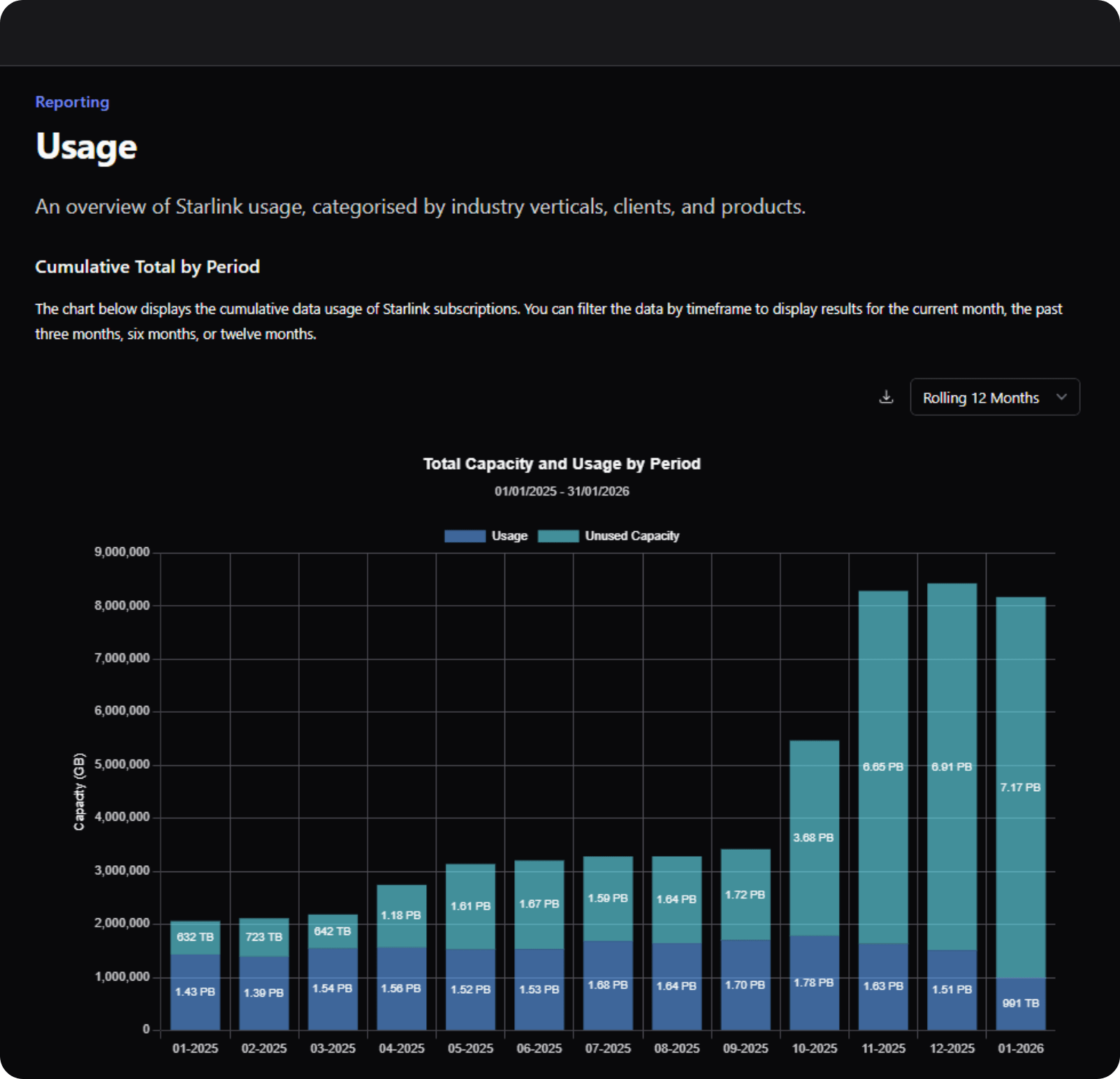
Control your Starlink estate with precision. Aavora helps you avoid overages, cut waste, and optimise pooled data — so you get more value from every terminal and every gigabyte.
Pooled Data Management:
Monitor and optimise shared bandwidth across terminals.

Predict future demand based on historical patterns.

Get notified at 70%, 90%, and 100% of pool usage.

Instantly identify high-usage terminals.

Enterprise-Ready

Admin & Security.

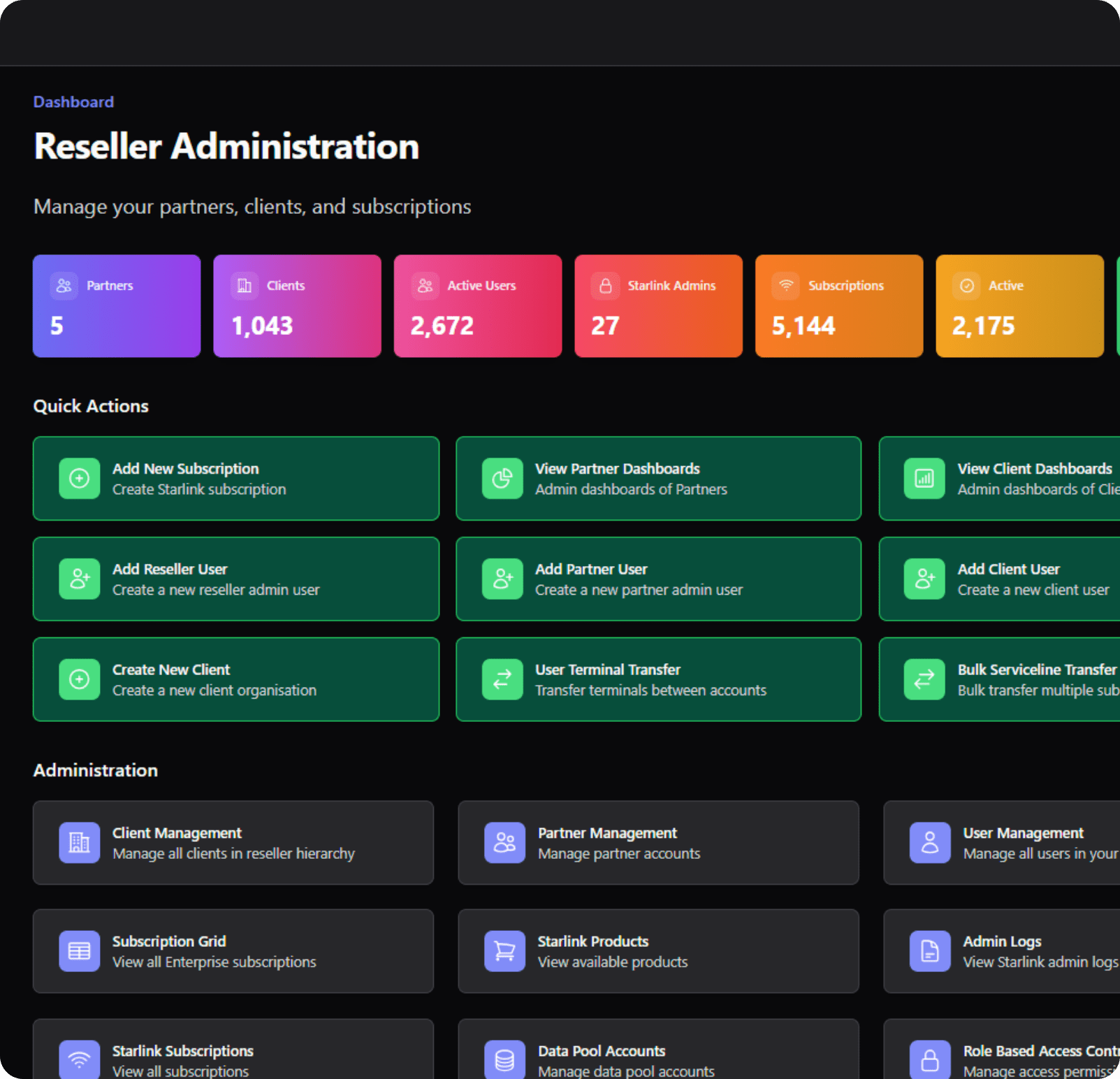
Built for security-conscious teams and multi-user environments, Aavora gives you full control over access, subscriptions, and system activity — with audit trails, MFA, and role-based permissions built in.

User Management:

Create user roles with granular access controls.

Assign and monitor plans per device or region.

Track all actions across your environment.

Encrypted data, GDPR-compliant hosting, and real-time threat monitoring.

Aavora Comparison:

Cost predictability:

Aavora:

Pool governance reduces overage risk

Starlink website:

Costs vary per terminal/subscription

Traditional network management tools:

Usually no Starlink billing/plan context

Aavora

Shared pools reduce wasted unused data

Starlink website:

Unused data can’t be reallocated across terminals

Traditional network management tools:

Can’t pool/allocate Starlink data; visibility is partial

Aavora

Forecasting + thresholds + alerts

Starlink website:

Manual checks; limited proactive controls

Traditional network management tools:

Alerts exist, but without Starlink usage/billing signals

Aavora

Groups, tags, filters aligned to operations

Starlink website:

Limited fleet structuring

Traditional network management tools:

Inventory often requires manual mapping to sites/assets

Aavora:

Bulk actions and repeatable workflows

Starlink website:

: Mostly one-by-one actions

Traditional network management tools:

Automation possible, but Starlink-specific actions need
integration

Aavora:

Ops dashboards + configurable alerts

Starlink website:

Limited alerting workflows

Traditional network management tools:

Strong monitoring, but limited Starlink context out of the box

Aavora

Clear timelines and operational notes (where enabled)

Starlink website:

Basic troubleshooting view

Traditional network management tools:

Strong ticketing/ITSM integration, but lacks Starlink estate
context

Aavora:

RBAC + auditability (where enabled)

Starlink website:

Basic user access model

Traditional network management tools:

Strong RBAC, but not tailored to Starlink estate actions

Aavora

Usage/spend by fleet, project, region, customer

Starlink website:

Limited finance-ready allocation

Traditional network management tools:

Usually not designed for connectivity plan cost allocation

Aavora:

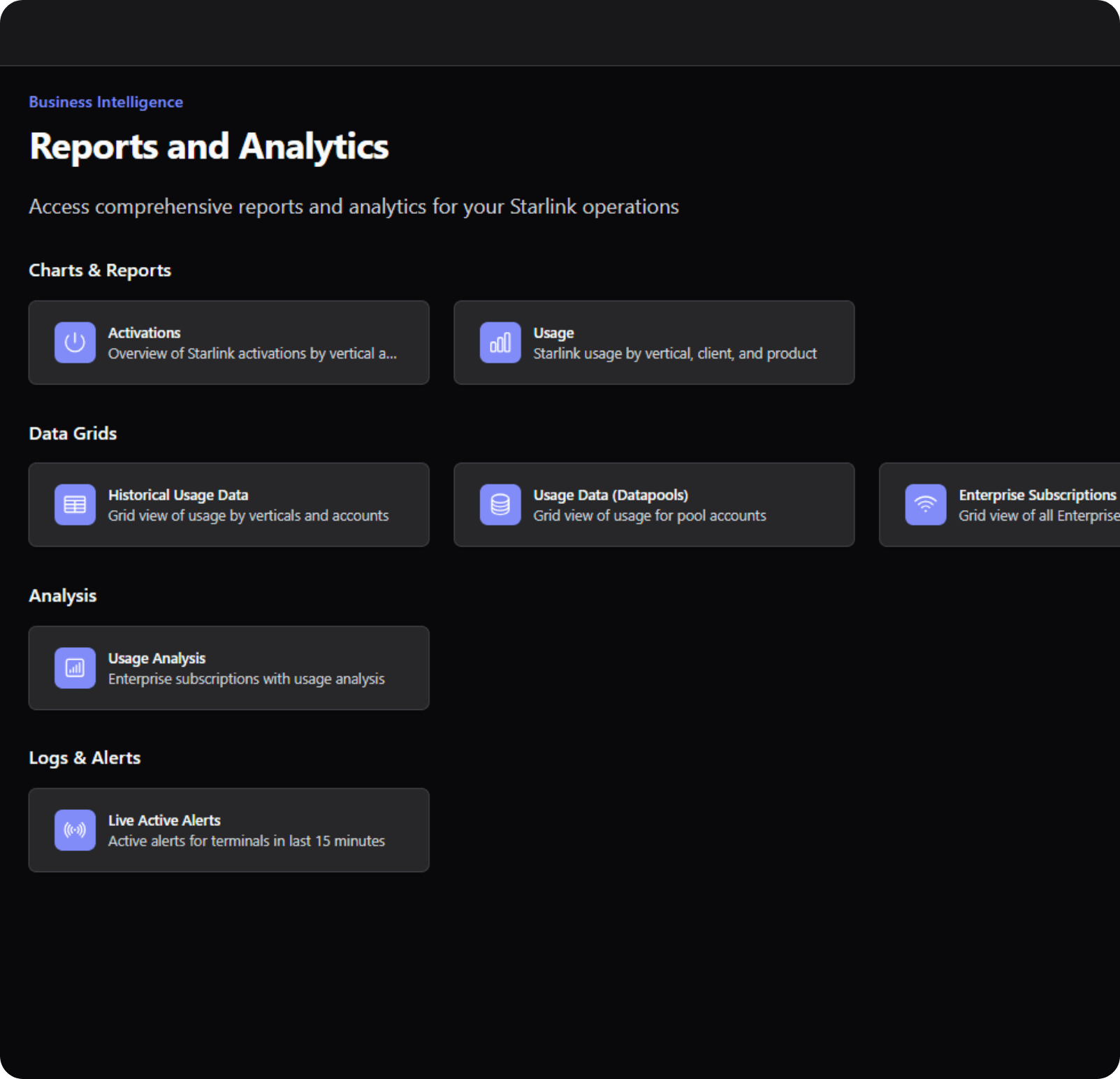
Stakeholder reporting across usage, cost, hotspots

Starlink website:

Limited reporting views

Traditional network management tools:

Strong network reporting; weaker commercial reporting

Aavora:

Starlink-aware API/exports for ops & finance workflows

Starlink website:

Limited integration options

Traditional network management tools:

Broad integrations, but Starlink data is harder to normalise

Aavora:

Built for large estates with control + insight

Starlink website:

Admin overhead grows with fleet size

Traditional network management tools:

Scales technically; integration effort grows per deployment

Starlink App

Traditional network
management tools

Cost predictability

Pool governance reduces overage risk

Costs vary per terminal/subscription

Usually no Starlink billing/plan context

Data efficiency

Shared pools reduce wasted unused data

Unused data can’t be reallocated across terminals

Can’t pool/allocate Starlink data; visibility is partial

Budget control

Forecasting + thresholds
+ alerts

Manual checks; limited proactive controls

Alerts exist, but without Starlink usage/billing signals

Fleet structure

Groups, tags, filters aligned to operations

Limited fleet structuring

Inventory often requires manual mapping to sites/assets

Bulk operations

Bulk actions and repeatable workflows

Mostly one-by-one actions

Automation possible, but Starlink-specific actions need integration

Monitoring & alerts

Ops dashboards +
configurable alerts

Limited alerting workflows

Strong monitoring, but limited Starlink context out of the box

Incident history

Clear timelines and operational notes (where enabled)

Basic troubleshooting view

Strong ticketing/ITSM integration, but lacks Starlink estate context

Governance & access

RBAC + auditability
(where enabled)

Basic user access model

Strong RBAC, but not tailored to Starlink estate actions

Cost allocation

Usage/spend by fleet, project, region, customer

Limited finance-ready allocation

Usually not designed for connectivity plan cost allocation

Reporting

Stakeholder reporting across usage, cost, hotspots

Limited reporting views

Strong network reporting; weaker commercial reporting

Integrations & API

Starlink-aware API/exports for ops & finance workflows

Limited integration options

Broad integrations, but Starlink data is harder to normalise

Scalability

Built for large estates with control + insight

Admin overhead grows with fleet size

Scales technically; integration effort grows per deployment

Why Teams Choose Aavora

Leading Starlink Resellers and enterprise customers choose Aavora to help with:

Purpose-built for Starlink estates

The operations platform built to run Starlink terminal estates at scale — with control, visibility, and cost certainty.

Operate at scale

Find what matters fast across regions, projects, customers, and fleets — then take action in bulk without the admin overhead.

Protect your budget

Pooled data visibility, guardrails, and alerts help prevent bill shock. Track usage by group and spot waste early.

Proactive monitoring that cuts downtime

Real-time status, configurable alerts, and incident history help your teams detect issues early and resolve them faster.

Analytics that drive decisions

Usage trends, cost drivers, hotspots, and forecasting — packaged into reporting that works for ops and stakeholders.

AWS hosted. Enterprise-ready controls

Hosted on AWS with role-based access and auditability — built for enterprise and public sector requirements.

Aavora Pricing Table

Aavora pricing

Three tiers built around visibility, control and commercial management for Starlink deployments at scale.

Tier 1

Essentials

Observe

For smaller customers and simple deployments needing real-time visibility with low operational complexity.

  • Live Global Dashboard
  • Real-time telemetry and performance
  • Analytics, Reporting, Alerts & Forecasting
  • Top customer & hotspot analysis
From $5 per terminal per month*

Tier 2

Premium

Control

For enterprise customers and multi-site deployments needing to actively manage their Starlink service lines.

  • Service line & subscription management
  • Data plan updates & terminations
  • Pooled data governance
  • Threshold alerts and usage guardrails
From $12 per terminal per month*

Tier 3

Pro

Monetize

For resellers, MSPs, and advanced enterprise customers running Starlink as a managed commercial service.

  • Multi-tenant org hierarchy
  • White labelling & customer portals
  • Full subscription lifecycle
  • API for telemetry and billing
  • Dedicated hosting option
From $15 per terminal per month*

* Onboarding fees apply, all pricing excluding tax.

FAQs

What is Aavora?

Aavora is the control layer for Starlink estates — visibility, governance, cost control. It brings your Starlink operations into one place, so teams can monitor performance, manage pooled data, control spend, and report clearly across multiple sites and assets.

Yes. For most customers, Aavora replaces Starlink Management as the primary way you manage and operate your estate — fleet-wide and at scale. You get the essentials plus the operational features the native tools don’t provide out of the box: pooled data control, cost allocation, role-based access, alerting, and customer-ready reporting.

Aavora is for organisations running Starlink beyond a basic setup — especially when you have:

  • Multiple sites, vehicles, vessels, or temporary locations
  • Multiple teams involved (IT, operations, finance, security)
  • A need for governance, uptime, and predictable costs

Aavora works across any vertical where connectivity is mission-critical, including:

  • Maritime & offshore
  • Rail & mobility
  • Energy & renewables
  • Construction & civil engineering
  • Public sector & emergency response

Aavora is built to remove the common pain points:

  • Less downtime with faster fault detection and resolution
  • One fleet view instead of scattered portals and spreadsheets
  • Clear accountability with structured access and audit trails
  • Lower waste with pooled data oversight and outlier detection
  • Fewer surprises with thresholds, alerts, and spend guardrails
  • Reporting you can use for stakeholders and service reviews

It helps you make pooled allowance work harder across fleets and teams:

  • Track pooled usage in one view
  • Spot heavy-use terminals early
  • Set thresholds and alerts before you hit limits
  • Understand usage by fleet/site/asset for better decision-making

Aavora turns usage into something you can actively manage:

  • Usage thresholds and alerts to prevent bill shock
  • Allocation views by fleet/site/asset (useful for chargeback)
  • Trends and forecasting to support budgeting
  • Actionable insight into what’s driving spend

Aavora is designed for operational control, including:

  • Fleet structure (regions, fleets, sites, tags)
  • Access and permissions (who can see/do what)
  • Alerts and thresholds (what gets flagged, when, and to whom)
  • Reporting views (by fleet/site/asset and over time)
  • Pooled data oversight and usage guardrails
Can we separate access by team, region, project, or contractor?

Yes. Aavora supports role-based access, so the right people see the right fleets — and only the controls they’re meant to use. This works well for multi-team operations and multi-party delivery models.

Yes. You can provide controlled access to dashboards and reporting, without giving full admin permissions.

Yes. Aavora is designed for multi-estate environments, with clear separation and governance—useful for groups with multiple business units, regions, or customer environments.

Aavora includes role-based access, audit trails, and governance controls designed for multi-team operations. It’s hosted on AWS, supporting secure deployment, resilience, and compliance-aligned operations.

Yes. Aavora supports data export and integration options so you can connect reporting and operations into your existing workflows (for example, service desks, asset systems, or reporting tools), where required.

Yes. Aavora is designed to fit real deployments, including hybrid environments (for example, Starlink alongside LTE/5G, SD-WAN, or other satellite links) where required.

Typically:

  1. Define fleet structure (regions, fleets, tags) and roles
  2. Connect the estate and validate visibility
  3. Configure dashboards, alerts, pooled data views, and reporting
  4. Go live, then refine based on operational use

Start with a quick estate review — number of terminals, locations, teams, and reporting needs — and you’ll get a recommended setup for visibility, governance, pooled data, and cost control.

Book a demo:

Copyright 2026 Aavora Limited

Scroll to Top